
Produkt
It all comes down to prompts: what the MCP interface in kanbau can do – and where it stops
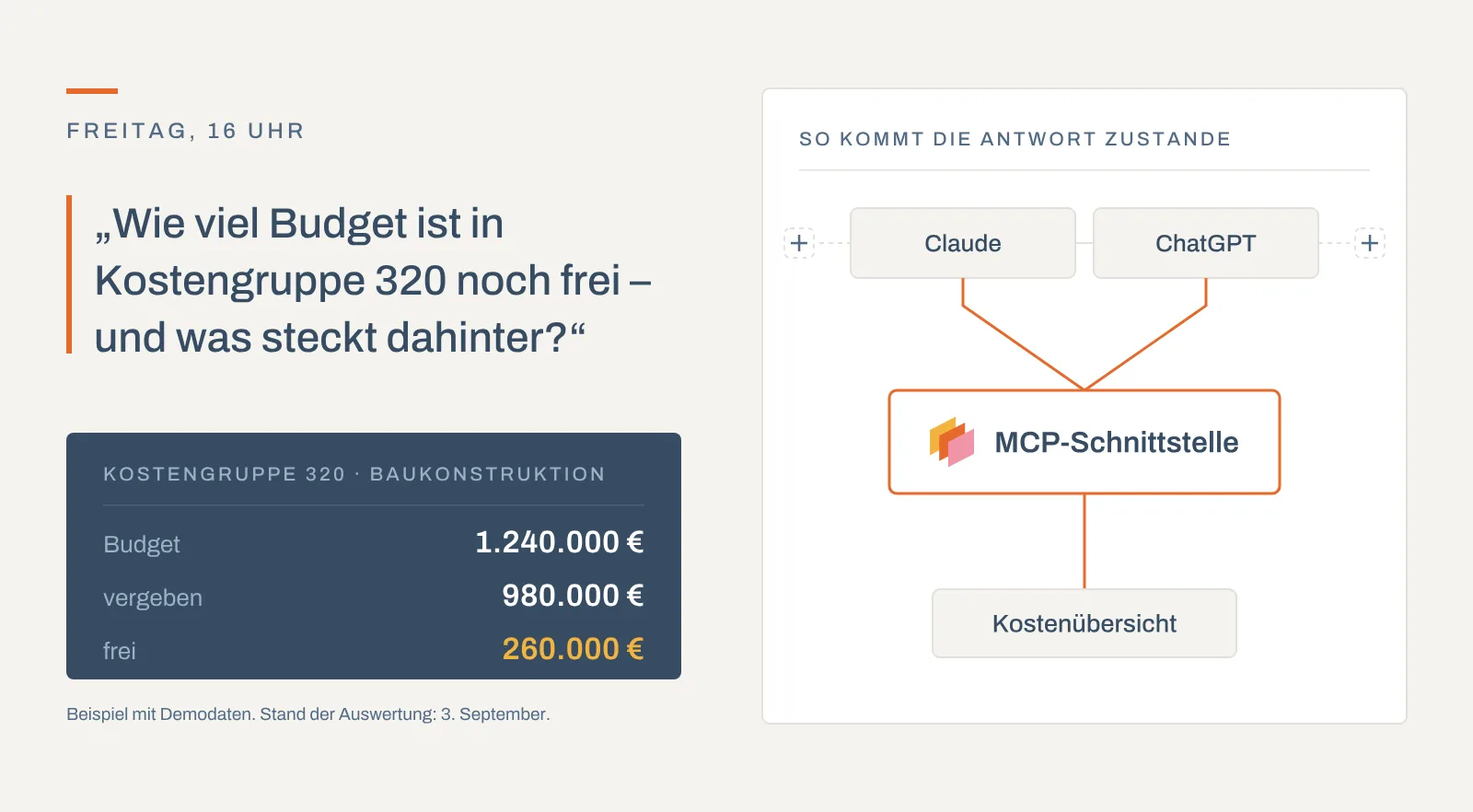
kanbau now has an MCP interface: your AI assistant works directly with your project data – explaining costs, reading contracts, recording invoices.
Eleven folders per employee, payroll records only for authorised users, retention periods on every folder and a log nobody can alter. Ready for mandatory electronic payroll records in Germany from 2027.
We provide the login details for the demo system.
One template with eleven described folders – records end up in the same place for every employee.
Payroll, health and warnings are visible to authorised users only. For everyone else these folders do not exist, not even in search.
Every file knows how long it must be kept – from the document date, the year end or the employee leaving.
Before the period ends, kanbau asks or blocks. A legal hold keeps records during proceedings.
Two rule sets included, assigned per legal entity. Both workforces in one system.
Chained log, access log and an export with a checksum per file for the payroll audit.
Adopt the ready-made personnel file proposal and adjust folders, descriptions, protection and retention as needed.
Germany or Austria as default; assign Austrian entities through the legal entity.
Apply the template per employee. Existing records stay, missing folders are added.
File records, handle notices and expired periods under “Filing & notices” and create the export for the audit.
On 31 December 2026 the option to be exempted from keeping payroll records electronically ends (section 8 (3) of the German Contribution Procedure Ordinance, BVV). Records received on paper have to be converted into an electronic format and must be available at any time and readable without delay throughout the retention period (section 9 (5) BVV).
The obligation covers part of the personnel file. If that part has to be digital, the whole file belongs in one place – for a property developer ideally in the same system as projects, working time and leave. kanbau turns the document storage into a file with rules.
The personnel file sits with the employee under “Attachments and documents”. kanbau provides a ready-made structure, and every folder has a description of what belongs in it:
| Folder | What belongs in it | Retention (Germany) |
|---|---|---|
| 01 Application and hiring | application, CV, references, personnel questionnaire | 6 months |
| 02 Contract and agreements | employment contract, written statement of terms, supplementary agreements | 3 years after leaving |
| 03 Payroll and social security | payslips, health insurance and notifications, tax, exemptions and evidence, pension | 6 years from year end |
| 04 Working time and absence | leave requests, maternity protection, parental leave, working time agreements | 3 years after leaving |
| 05 Qualifications and safety training | training, health and safety instructions, driving licence checks, forklift or crane certificates | 3 years after leaving |
| 06 Health | occupational health certificates (without findings), reintegration management | 3 years after leaving |
| 07 Appraisal and development | appraisal interviews, target agreements | 3 years after leaving |
| 08 Formal warnings | warnings and counter-statements | 2 years |
| 09 ID and residence | residence permits, work permits, documents employees must carry on construction sites | 3 years after leaving |
| 10 Leaving | notice, termination agreement, reference, employment certificate | 3 years after leaving |
| 11 Correspondence and other | anything that fits nowhere else | 3 years after leaving |
You set the structure up once as a template; the proposal can be previewed and adjusted freely. For a new employee you apply the template directly. For employees who already have records, kanbau only adds the missing folders – folders and files with the same name stay as they are.
The folders payroll and social security, health and formal warnings are protected. Only users with elevated permission for HR, plus admins and owners, see them. For everyone else these folders do not exist: they appear neither in the list nor in search, and their files cannot be opened or downloaded. A click on the lock shows exactly who has access.
You protect further folders with a right-click. Roles stay separate: a line manager approves leave for the team without seeing the personnel file.
Every folder of the personnel file comes with a filing rule. Depending on the type of record, the retention period starts at the document date, at the end of the document year or when the employee leaves – until then the file stays protected. Each file shows the date until which it must be kept.
You set how strictly the period applies: hint asks before deletion, lock prevents it. With a lock, only owners can override, with a mandatory reason; the other owners and admins are notified. Archiving counts as deletion. A legal hold keeps records regardless of any period, for example during labour court proceedings.
If a file is moved into a folder with a shorter period, it takes its period along. A retention period never shortens silently. Once it has expired, the file appears under “Period expired” for review – kanbau never deletes on its own.
A rule set defines how long records are kept and how strictly this applies. Two are included, you can add more. Assignment works through the legal entity: employees of an Austrian company follow the Austrian periods, everyone else the German ones.
| Period | Germany | Austria |
|---|---|---|
| Payroll records | 6 years from year end | 7 years from year end |
| Applications | 6 months | 7 months |
| Contract, health, general personnel file | 3 years after leaving | 3 years after leaving |
| Formal warnings | 2 years from issue | 2 years from issue |
The personnel file proposal also comes in two versions, the Austrian one with folder names that follow Austrian terminology. If you change a rule set, existing files stay unchanged until you deliberately apply the change.
Everything the filing rules report and log is collected under Filing & notices in the company menu – for all employees on one page.
Employee master data, working time recording, leave and absence planning and the personnel file share the same employee record. Payroll itself stays in your payroll software; the file holds the records that payroll produces and that reach you.
The digital personnel file in kanbau is the “Attachments and documents” area of an employee, with a fixed structure of eleven folders, protected folders for confidential records and filing rules per folder. The rules define how long records are kept, how files are named, who is notified of changes and whether access is logged.
No. In Germany, payroll records under section 8 of the Contribution Procedure Ordinance (BVV) must be kept electronically; the option to be exempted ends on 31 December 2026. If that part has to be digital anyway, it makes sense to keep the rest of the file in the same place.
The folders for payroll and social security, health and formal warnings are visible only to users with elevated permission for HR, plus admins and owners. Everyone else does not see these folders, not even in search, and cannot open or download their files. A line manager approves leave without access to the personnel file.
Retention is set per folder: applications six months, payroll records six years from the end of the document year, contract and general personnel file three years after the employee leaves, formal warnings two years – each under German law. Austrian entities use the values of the Austria rule set. Duration and legal basis can be adjusted; kanbau never deletes on its own when a period ends but lists the files for review.
Under “Filing & notices” you create an export: all files of a retention type as a ZIP file, ordered by employee and folder, with a table of contents as CSV and HTML. It lists a checksum (SHA-256) for every file, showing that the file has not changed since it was filed. The export itself is logged as well.
kanbau now has an MCP interface: your AI assistant works directly with your project data – explaining costs, reading contracts, recording invoices.
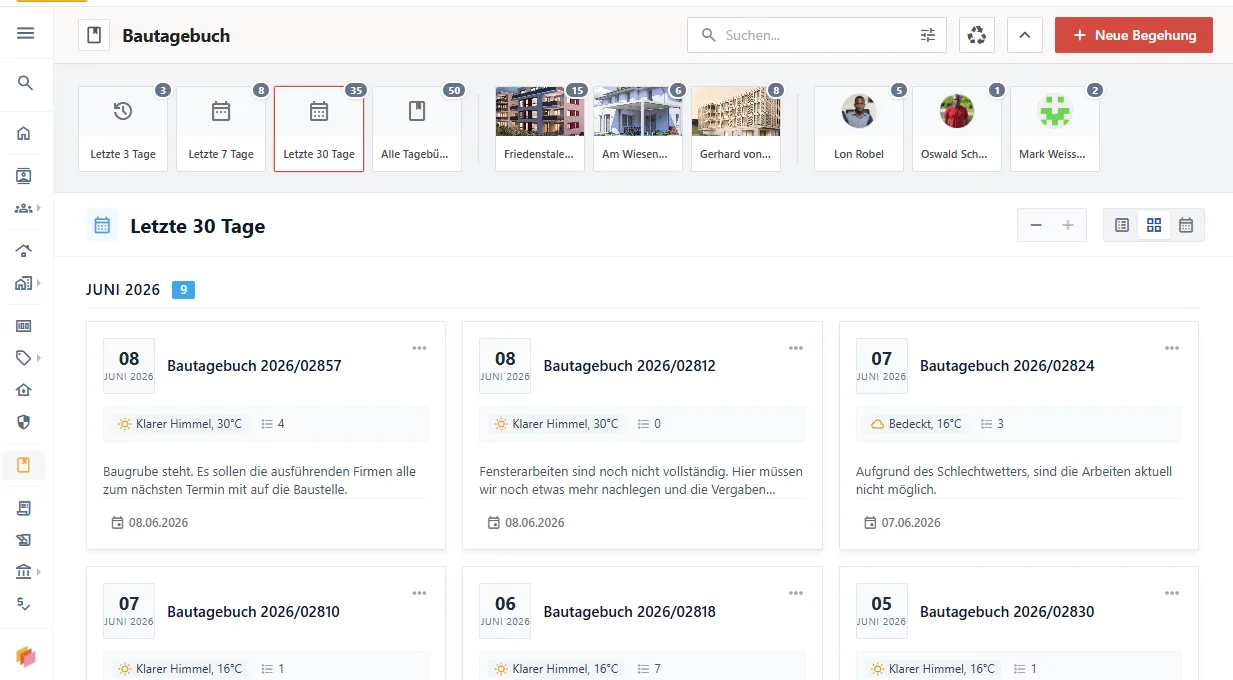
New in kanbau: the site diary for property developers – AI text recognition, automatic weather data, digital signatures and PDF in one click.

Choosing software for property developers: an all-in-one approach, speed, mobility and ease of use as criteria – and how kanbau addresses them.

30 minutes, with your questions and your processes.
Book a demoor call: +49 911 477 133 80